

Dividends for Validators
How are emissions calculated for Validators?
Section titled “How are emissions calculated for Validators?”VTrust
Section titled “VTrust”- Validators test miners and create a weighted list of scores. These are submitted to Yuma Consensus.
- These scores are compared to the other validators — each validator is judged to be in consensus with the rest of the validators.
If a validator is judged to be out of consensus, their VTrust (validator trust) decreases. VTrust is a value between 0 and 1, where 0 is terrible and 1 is perfect.
The other input to validator emissions is stake weight. Validators with higher stake weight receive higher emissions.
- root_stake: TAO staked to a validator on root.
- tao_weight: defined on chain as 0.18.
- alpha_stake: alpha staked to a validator on the subnet.
- total_stake: the value used to determine emissions.

Dividends
Section titled “Dividends”Dividends are the percentage of total validator emissions awarded to each validator. They are calculated from VTrust and total_stake. High stake and high VTrust lead to high dividends, and high dividends yield high emissions.
- The sum of all dividends on a subnet is 1.
- The dividend score is calculated once per tempo (360 blocks for most subnets).
Calculating Validator Emission
Section titled “Calculating Validator Emission”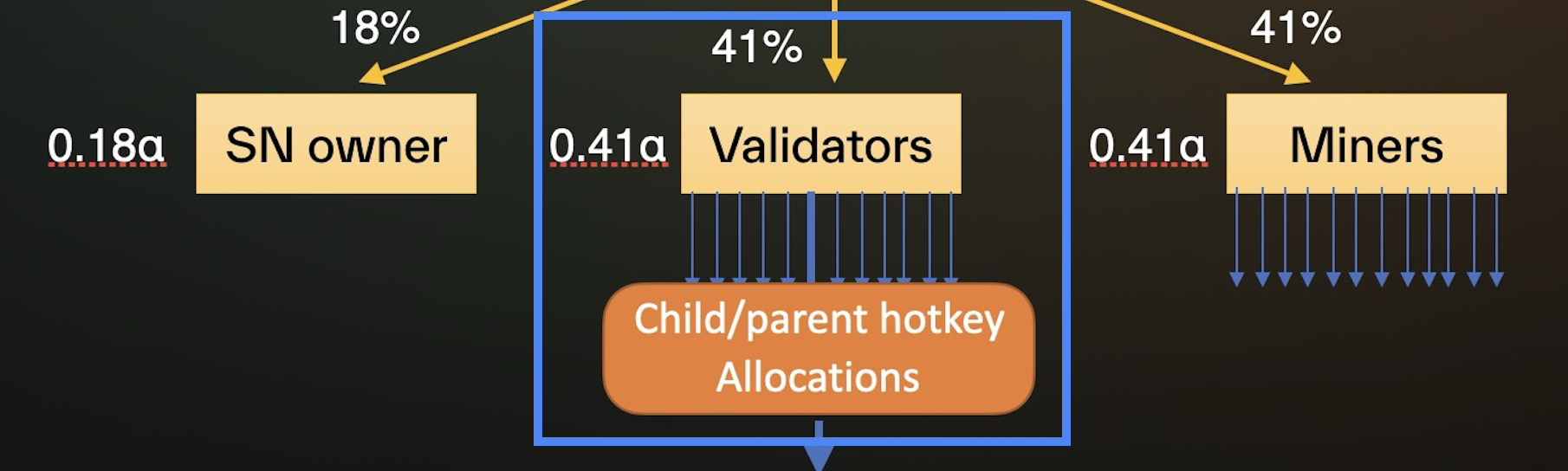
- Validators receive 41% of the
alpha_outsubnet emission. - The validator’s dividend score gives the fraction of the validator alpha that is awarded.
Validator rewards
Section titled “Validator rewards”The validator’s subnet emission is further split by several factors:
- Parent hotkeys receive their percentage of the stake.
- The validator may take a
child_takefrom this emission.
- The validator may take a
- Each subnet has a root:alpha proportion that divides the emissions.
- Both alpha and root proportions may have a validator take.
- This is the reward for the validator.
- The remaining root and alpha reward is divided amongst stake nominators.
Next Steps
Section titled “Next Steps”- Root Validator Baskets — how root dividends are curated into a basket under Root Reborn.
- Emission for Parent/Child Hotkeys — dividing dividends to parent/child hotkeys.
- Emissions: Root vs. Alpha Stake — dividing between root & alpha proportions.
- Stakeholder Emissions: Root & Stakeholder Emissions: Alpha — distribution of emissions to stakeholders.